Prices and features checked November 2026. Tools change; check theirs before you decide. Visit Lasting's site.
Choose Lasting if you want a guided program of sessions that work on the relationship itself, such as communication, conflict, trust and intimacy. Choose Tiptoe if you want a shared system for tasks, chores and a weekly check-in, with clear owners for the work. Lasting teaches relationship skills, and Tiptoe helps you run a week together, so many couples will know quickly which one they need.
This comparison uses Lasting's own site and App Store listing, opened in November 2026. We could not open Lasting's checkout page, so some plan details below are what the store listing shows. Apps change, so check before you pay. We make Tiptoe, so please read this page with that in mind.
Who should choose which?
Choose Lasting if:
- You want to work through structured material on your relationship, in order, with your partner.
- Communication or conflict itself is what you most want to improve.
- You like learning through sessions, and you'd do them regularly.
- You'd like content that draws on published relationship research.
- One of you uses Android. Lasting has an Android app, and Tiptoe doesn't.
Choose Tiptoe if:
- You mostly get along, and the household is where things go wrong.
- You want a shared to-do list, chores with one owner, and a calendar.
- You'd like one weekly conversation that ends with decisions and owners.
- You want something practical you can use on an ordinary Tuesday, rather than a course.
- You want to use it on a computer as well as a phone.
Side by side, as of November 2026
Price
- Lasting: Free to download. The US App Store listing shows in-app purchases of Lasting Premium at $11.99, $14.99 and $79.99, and Lasting Plus at $19.99 to $89.99, without saying which billing period each one covers. It offers monthly or yearly subscriptions with a free 7-day trial. Check the price you're shown before you buy.
- Tiptoe: Free for both partners with no card. The free account includes the couple's first 30 tasks and chores, combined, and every one created counts, even if deleted. Pro is $9.99 per month, billed monthly, and upgrading charges right away.
Cost for two
- Lasting: Premium unlocks the entire app "for two users", according to the listing.
- Tiptoe: One Pro subscription covers both partners.
What the free plan gives you
- Lasting: The five-session Foundations series, conversation starters, relationship reminders and single sessions, per the listing.
- Tiptoe: The first 30 tasks and chores, plus recurring chores, lists, the calendar, thank-yous, reminders and the weekly check-in.
Platforms
- Lasting: iOS and Android. The US App Store listing shows iPhone, iPod touch and iPad (version 13 or later) and Apple Vision, with version 3.2.30 dated February 19, 2025 as the latest shown when we checked. We did not find a web version.
- Tiptoe: iPhone and the web at app.tiptoe.ai. No Android app.
Main activity
- Lasting: Hundreds of sessions on topics that include communication, conflict, repair, emotional and sexual connection, trust, money and family culture.
- Tiptoe: Tasks, chores and lists with owners, a shared calendar and a weekly check-in at a time you choose.
Research basis
- Lasting: Its research page says the program draws on 126 studies by 202 researchers, naming John Gottman and Sue Johnson among others. That page doesn't describe a study of the app itself.
- Tiptoe: Doesn't make research claims about the app. Our guides cite outside research where it's relevant, and our four jobs model draws on Allison Daminger's work on cognitive labor.
Chores and tasks
- Lasting: The listing doesn't describe task or chore features.
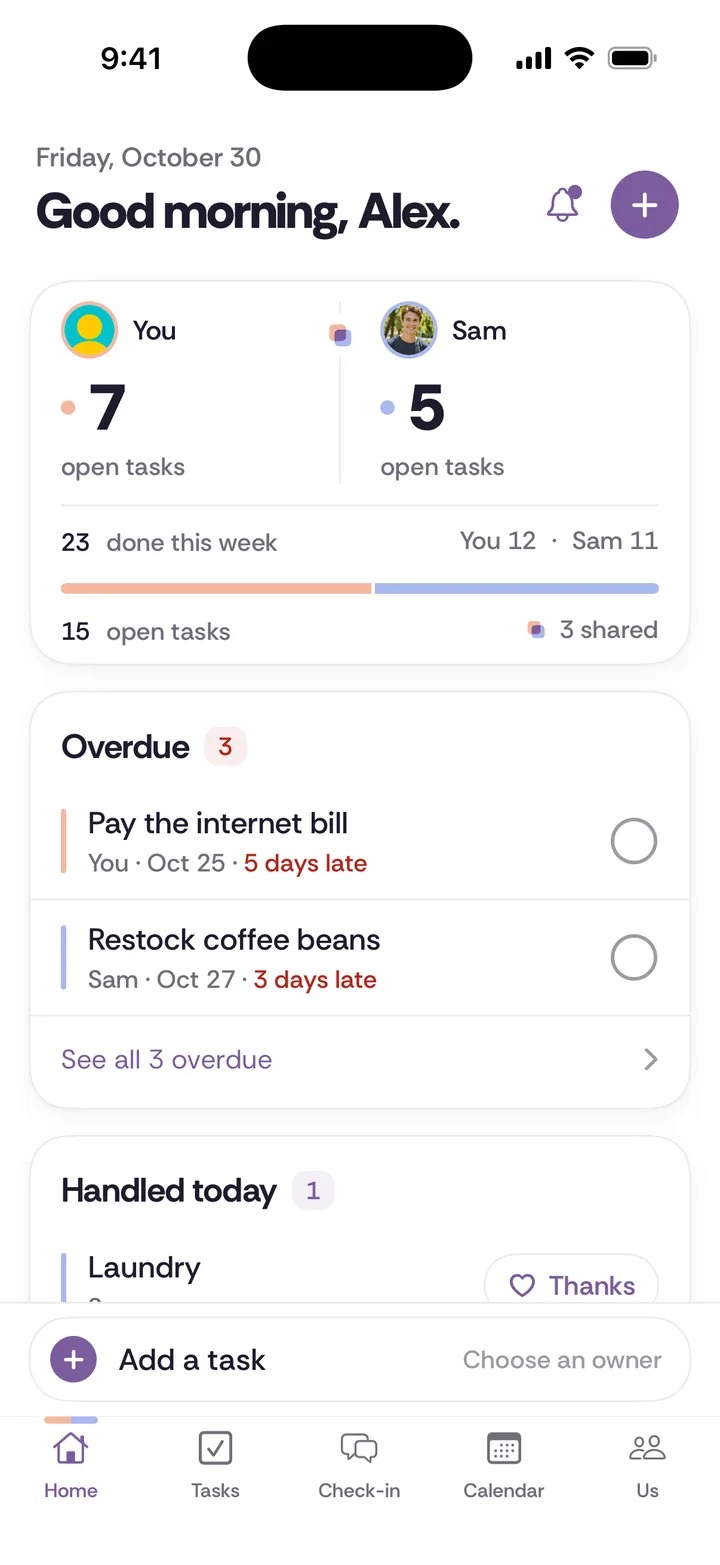
- Tiptoe: This is the core. Tasks can be assigned to You, your partner or Together. Chores repeat on a schedule and have one owner. Completed items count for the person they were assigned to.
Calendar
- Lasting: The listing doesn't describe a calendar.
- Tiptoe: One calendar with both partners' plans, key dates and tasks with a day or time. Connecting an existing calendar is optional.
Company and status
- Lasting: Its site's footer says it's a Talkspace company. The site describes the app as a marriage counseling and couples therapy program. The App Store listing says it isn't medical, psychological or mental health advice, and isn't a substitute for a qualified professional. It shows 4.7 out of 5 from about 25K ratings.
- Tiptoe: Not therapy, diagnosis, treatment or a crisis service, and it doesn't promise relationship outcomes.
Privacy notes
- Lasting: Its App Store label, reported by the developer, lists contact info, user content, identifiers, usage data, sensitive info and diagnostics as data linked to you.
- Tiptoe: No bank linking or location tracking. Data is stored on AWS in Ohio, with separate private and shared records.
What Lasting does better
Teaching relationship skills. Tiptoe's check-in gives you a place to talk. It doesn't teach you how. Lasting's sessions take on things like how conflict works, how to repair and how to reconnect, in a way a to-do app simply doesn't. If you and your partner keep having the same fight about nothing, more organization probably won't help, and a skills program might.
Range of topics. Sex, trust, emotional connection and family culture are all in Lasting's list. Tiptoe stays out of most of these. If that's where your concern lies, this settles it.
Structure. A set series of sessions gives you something to follow, and many people find that easier to start than an open conversation. You don't have to work out what to talk about, since the session does that for you.
Android. Lasting has an Android app, and Tiptoe doesn't. That can be a deciding factor if one of you is on Android.
A clear free starting point. A five-session Foundations series gives you a real sense of the approach before you pay anything.
What Tiptoe does differently
It runs in your actual week. Lasting is something you sit down to do. Tiptoe is something you check when the school form arrives. A task has an owner, a due date and notes, and a chore has one owner and a schedule. You can use it daily without having any kind of relationship conversation at all.
It works on the source of a lot of friction. A course can teach you how to raise the dishes without a fight. It won't decide who owns the dishes. For couples whose arguments are mostly about the mental load, naming who notices, plans, does and follows up may remove the argument instead of improving how you have it.
Decisions become assignments. At the weekly check-in, either of you can add topics during the week, you talk at a time you've picked, and what you decide becomes a task with an owner. That's a modest thing. It's practical, and it keeps a good conversation from fading by Wednesday.
Small signals. You can send a thank-you or a Thinking of You, and nudge about an overdue item instead of asking again in person.
It doesn't present itself as counseling. Some couples will find that a relief, because they don't feel anything is wrong. For others that's a limitation, and a program focused on the relationship will suit them better. If things feel serious, a qualified counselor is a better next step than either app. If you're afraid of your partner, or if a conversation could make you less safe, skip both tools and see our safety page.
Which do you need first?
Here's a quick way to sort it. Imagine the household work were completely fair and took care of itself tomorrow.
- If you'd feel mostly fine, the work is your issue. Start with who owns what.
- If you'd still feel distant, or you'd still fight in the same way, the relationship itself is where to put your effort. A program like Lasting, or a counselor, makes more sense.
- If you can't tell, try each for a week: one Foundations session, and one whole-job handoff. Notice which leaves you with more relief.
The two can feed each other, too. Being able to start softly and repair makes chore conversations easier, and fewer repeated reminders leave more room for everything else.
One argument, two tools
Say the same fight keeps happening. The kids' forms sat until the morning they were due, you said something sharp, your partner got defensive, and by breakfast neither of you was speaking.
- With Lasting, the useful part is the sharp moment. Its session topics include conflict and repair, so you might work on what to say when it starts to go wrong, and what to do afterward.
- With Tiptoe, the useful part is the form. School paperwork becomes one person's job, with the noticing included, so it may not be sitting there on the morning it's due. The next time something similar comes up, it's a topic for the check-in rather than a breakfast argument.
Both responses are reasonable. They just address different parts of the same morning. Ask which part you'd most like to change.
Could you use both?
Yes. They barely overlap. You might do a Lasting session on conflict and then use your Tiptoe check-in to decide what changes this week. The limit is your time. A program only helps if you actually do the sessions, so be realistic about how many routines you'd keep up.
Switching from Lasting to Tiptoe, or the other way
There's little to transfer, because the two hold different things.
Step 1. Note what you learned in Lasting that you want to keep, such as a phrase or an agreement. Write it down somewhere you'll see it. Tiptoe's check-in can hold it as a topic.
Step 2. Moving to Tiptoe, list your recurring household jobs, then give each one owner. Our chore split calculator shows each person's weekly hours, including the planning.
Step 3. Enter the jobs that cause the most friction first, since the free limit is 30 tasks and chores in total.
Step 4. Moving to Lasting from Tiptoe, begin with the free Foundations series and keep Tiptoe or a paper list for the work.
Step 5. If you have a paid subscription, cancel where you bought it. The App Store listing says subscriptions renew automatically unless turned off at least 24 hours before the period ends.
You can view Tiptoe through a no-account demo, and the pricing page lists what's in Free and Pro.
The free option that uses neither app
For the relationship side, the Gottman Institute publishes free articles, including on softening how you start a hard conversation and on repair. Reading one together and talking about it for 15 minutes is a real, if unguided, version of a session. Our check-in question library has 40 prompts, and the communication guide offers more.
For the work, write down each recurring job with one owner on a sheet of paper, or use our chore split worksheet. Add a short weekly talk from the check-in guide. If a month of that isn't enough, you'll have a clearer idea of which kind of help to pay for.
Try it in Tiptoe
Use the public demo to compare one real responsibility, then read the plans and terms. Free for both of you. Pro is $9.99/month. No card needed. Your first 30 tasks and chores are free.
Questions before choosing
Is Lasting free?
Lasting is free to download, and its free content includes the five-session Foundations series, conversation starters and single sessions, according to its App Store listing as of November 2026. Premium is a paid subscription with a free 7-day trial.
Is Lasting real therapy?
Lasting's site describes it as a marriage counseling and couples therapy program. Its App Store listing also says it isn't medical, psychological or mental health advice and isn't a substitute for a qualified professional. If you need clinical care, speak to a licensed therapist.
Does Lasting use Gottman research?
Lasting's research page names John Gottman among the researchers whose work it draws on, along with Sue Johnson and others, and it cites 126 studies overall. Those are studies it used to build the program. The page doesn't describe a study of the app itself.
Can I use Lasting or Tiptoe if my husband or wife won't join?
Tiptoe's value depends on sharing a space with your partner. We couldn't confirm how much of Lasting works alone. For a boyfriend or girlfriend, the same applies. The free paper version of either job is an easy place to start on your own.
Is Tiptoe a replacement for couples counseling?
No. Tiptoe is not therapy, diagnosis, treatment or a crisis service, and it doesn't promise any outcome for your relationship. It's a shared place to keep tasks, chores and agreements, and a weekly check-in.
Do we need to replace our current tool?
No. Keep it if both people use it and it handles the problem. Choose clear boundaries if you use more than one tool, so you do not maintain competing versions of the same plan.
What does it cost for two?
Tiptoe is free for both of you. Pro is $9.99 a month and adds unlimited tasks and chores, Insights, every past check-in, a calendar feed and email tasks in. No. You share one space, and Free covers both of you. If you choose Pro, one subscription covers both partners. Your free account includes your first 30 tasks and chores. Every one you create counts, open or done, and deleting one doesn't give it back.
Is there a native iPhone app?
Tiptoe is on iPhone, and the same shared week is on the web at app.tiptoe.ai.