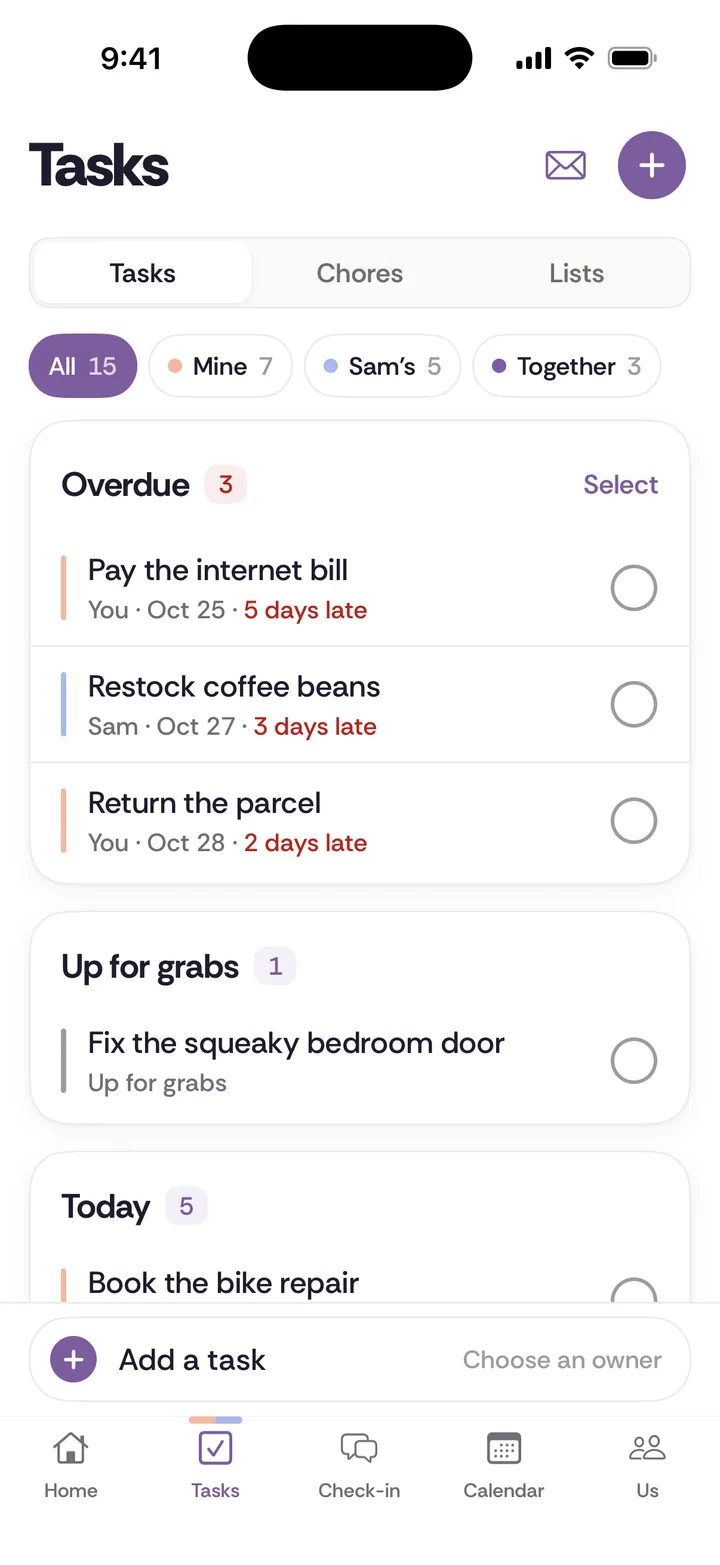
A chore app for couples should give each recurring job one owner who handles all of it, not just the doing. Chores in Tiptoe live inside Tasks: each one has a single owner and a repeat schedule, gets logged when it is done, and can change hands only when the owner proposes a handoff and the other partner accepts.
Who is this for?
Couples who already split chores on paper but still end up with one person running the system. Maybe a husband does the dishes every night but his wife still notices the dishwasher salt is out. Maybe a girlfriend takes the trash out when asked, and her boyfriend is the one who remembers it is collection day. In both cases the chore is split, and the thinking is not. This feature is for moving the thinking too.
What problem does it solve?
Taking out the trash looks like one job. It is really four: notice the bin is full, remember collection day, buy bags before they run out, and put the bin back. When one partner does the carrying and the other does the noticing, the noticer becomes a reminder service, and every reminder sounds like a complaint.
A chore with one owner holds all four jobs. The owner does not wait to be asked, because there is nobody to ask them. This is the difference between helping and owning, and it is the core of the four jobs behind every chore.
It also changes how credit works. A done chore counts for the person it was assigned to. You are not tallying who did more. You are agreeing up front who holds what, and the record follows from that.
How it works, step by step
Step 1. List the chores that repeat. Laundry, trash and recycling, bathroom, bills, plants, the litter box, the car. If you need a starting list, use the list of household chores.
Step 2. Add each one as a chore in Tasks. Name it as the whole job: "Trash and recycling, including bags and bins back in" rather than "trash."
Step 3. Give it one owner. One person, not both. Shared chores tend to become the chore whoever cares more ends up doing.
Step 4. Set the repeat. Pick the days, choose weekdays or weekends, or set it monthly or quarterly. The schedule should match the real rhythm of the job, not an ideal one.
Step 5. Log it done when it is done. The chore and its history are shared, so you can both see it is handled without asking.
Step 6. Propose a handoff when life changes. A new job, a newborn, a broken wrist, a season of travel. The owner proposes the handoff, and the partner either accepts it or keeps things as they are. A proposed handoff is a request, not an automatic reassignment, and your partner can see it.
Step 7. Say thanks. Not because the job was a favor. Because noticing work out loud is part of keeping it fair.
Three household examples
- Laundry for a family of four. "Laundry" becomes one chore owned by one partner, repeating on Monday, Wednesday and Saturday. The owner also owns detergent, the kids' outgrown clothes pile, and knowing which sweater cannot go in the dryer. The other partner stops asking "is there a load in?"
- The quarterly air filter and smoke alarm check. Nobody ever remembers these. One chore, set to quarterly, owned by the partner who is home more on weekends. The owner keeps the filter size in the notes and buys the next one.
- Bills during a job change. One partner has owned bills for years. A new job with long hours starts next month. Instead of quietly dropping things, they propose a handoff of the monthly utilities chore. The other partner accepts it, or says "keep it until the end of the month and we'll swap then," and nothing falls through in the gap.
What it does not do
- It does not pick owners for you. The split is a conversation. Use the chore split calculator or the chore split worksheet to have it with real numbers.
- It does not score either of you. There is no points system or leaderboard. If you want a chart of completed tasks and chores by person over the weeks, that is Insights, which is part of Pro.
- It does not reassign anything on its own. A handoff only happens when your partner accepts it.
- It cannot make a partner who does not want to share the work want to. A clear owner removes confusion, which solves a lot. It does not solve a disagreement about whether the work is fair. For that, start with splitting chores fairly.
- Free covers the couple's first 30 tasks and chores, combined, and recurring chores are included in free. Pro is $9.99 a month for both of you and removes the limit.
How does it compare to a notes app, Apple Reminders or paper?
A notes app can hold a chore list, and that is a fine place to write the first draft. It has no owner, no schedule and no record of when something was last done, so the person who opens it most still ends up running it.
Apple Reminders can handle repeating items and, as of November 2026, Apple's support page says you can assign a reminder to someone once the list is shared, and reassign or remove that assignment later. If you both use iPhone and only need "who does it, and when," that may be all you need. What it does not describe is an agreed handoff, where one partner asks and the other accepts. Apple also says notifications you set are not shared with anyone else, so check that each of you sets your own.
A paper chore chart is free, visible and works. Write each chore once with one name next to it and the day it repeats. Its limits are that it stays on the fridge, it does not keep history unless you keep the old sheets, and changing an owner means crossing out a name. If you want a free version first, print the chore split worksheet and run it for a month.
Tiptoe is worth it when the chart works but the handoffs and the follow-up are still happening in conversation.
How to start this week
Pick the one chore that causes the most reminders in your house. Make it a single chore with a single owner and a real schedule, and agree that the owner holds the noticing too. Try that for two weeks before adding anything else. If you need words for the conversation, the what to say tool has them.
Related guides
- The complete guide to splitting chores as a couple
- Chore split for couples
- When your partner doesn't help
- Best chore apps for couples
- Tasks with owners and the weekly check-in
Questions about chores
What is the best chore app for couples?
The best one is the one where every chore has one owner and a schedule you both see. Tiptoe gives each recurring chore one owner and lets you propose a handoff when life changes. Our [comparison of chore apps for couples](/best-chore-app-for-couples/) covers the alternatives fairly.
How do I get my husband or wife to do chores without asking?
Move the whole job, not just the task. When one person owns a chore from noticing to follow-up, there is nothing left to ask about. Agree on the owner and the schedule once, then step back.
Should my boyfriend or girlfriend and I split every chore 50/50?
Not necessarily. A split that matches your schedules and hours is often fairer than an even count. The [chore split calculator](/tools/chore-split-calculator/) shows weekly hours per person, including the planning, so you can see the real balance.
What happens when the person who owns a chore cannot do it anymore?
In Tiptoe, the owner proposes a handoff. Your partner can see it and either accepts or keeps things as they are. Nothing is reassigned automatically.