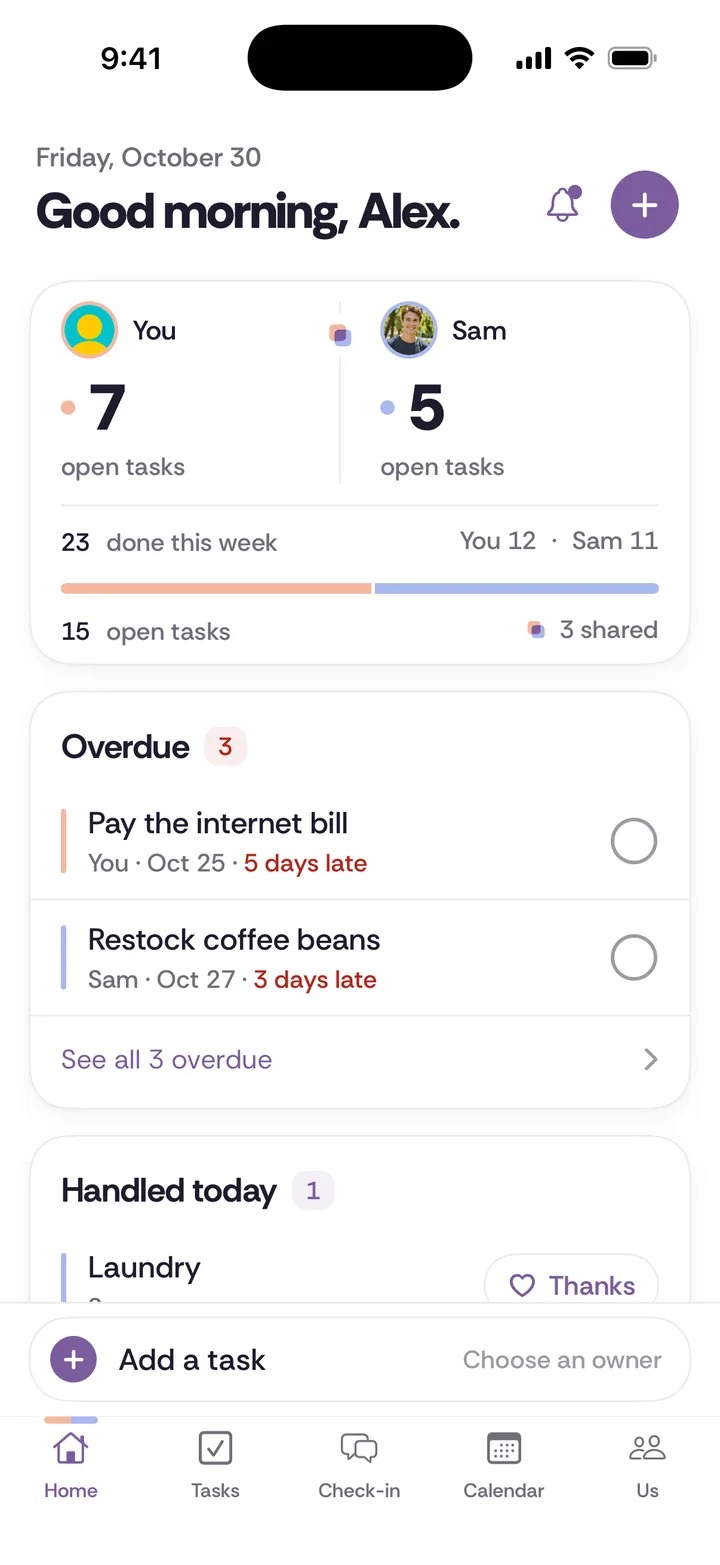
A weekly check-in for couples is a short, scheduled conversation where you say thanks, look at the week ahead and talk through one or two things, then write down what you decided. The Tiptoe check-in gives that conversation a fixed day and time with a reminder, a list of topics you both add to during the week, and a way to turn each decision into a task with an owner.
Who is this for?
Couples whose important conversations happen at the worst moments: in the car, at 11pm, in the middle of an argument about something else. A husband who saves everything up until it spills over. A wife who brings up the calendar while he is cooking. A boyfriend and girlfriend who both mean to talk about the holidays and keep not doing it. If the only time you discuss the house is when something has gone wrong, a check-in gives those topics a better time.
What problem does it solve?
Small things that do not get said turn into big things that do. Without a set time, one partner ends up deciding when to raise a topic, which means reading the other person's mood and waiting for a "good moment" that rarely comes. That is the tiptoeing. A standing weekly time removes the guessing. The topic has a place to go, and both of you know when it will come up.
The second problem is follow-through. Plenty of couples have a good talk, agree on something, and then nothing changes because nobody wrote it down or took it on. Here a decision becomes a task with an owner, so "we should book the pediatrician" turns into a task that belongs to one of you.
How it works, step by step
Step 1. Choose a day and time together. Pick one that works for you both, with a reminder. Sunday evening after the kids are down, or Thursday lunch if you both work from home. Short and regular beats long and rare.
Step 2. Add topics during the week. Either of you can add a topic when it comes to mind, so nothing has to be remembered on the spot. "Thanksgiving: your parents or mine?" "The car is making that noise again." See check-in topics for more on this.
Step 3. Start with thanks. Name one specific thing the other person handled. Specific is the point: "You dealt with the insurance call and I didn't have to think about it" lands; "thanks for everything" does not.
Step 4. Look at what is coming. The week's plans, deadlines and who is doing what. Your shared calendar is useful here.
Step 5. Talk topics through, one at a time. Do not try to clear the list. One or two is plenty. A topic that needs more room can wait for next week.
Step 6. Turn decisions into tasks. Each decision becomes a task with one owner. That is how the conversation leaves the couch.
Check-in topics, decisions and next steps are shared with your partner. Nothing is sent to anyone else.
Three household examples
- The holiday plan. One partner adds "Holidays: who are we seeing and when?" on Tuesday. On Sunday you talk it through and decide: Thanksgiving with one family, Christmas morning at home. Two tasks come out of it: one of you calls your mother by Wednesday, the other books the train.
- The uneven week. One partner had a brutal work week and the house slid. Instead of resentment building quietly, it goes on the list: "I dropped a lot this week, can we move two chores?" The decision is a handoff of the grocery run for two weeks, with a date to look again.
- The money question. "Should we keep paying for three streaming services?" goes on the list. It takes four minutes. One partner owns cancelling two of them by Friday. The couples money guide is there for the bigger ones.
What it does not do
- It is not therapy, counseling or a crisis service, and it does not promise any outcome for your relationship. It is a structure for an ordinary conversation.
- It does not tell you what to talk about. You add the topics. For prompts, see the weekly check-in guide.
- It will not make a reluctant partner show up. If one of you keeps skipping, that is a topic in itself, and it is worth saying plainly.
- If a conversation involves fear, control or threats, a scheduled check-in is not the right tool. Read our safety page first.
- The weekly check-in is included in the free account. Pro adds every past check-in.
How does it compare to a notes app, Apple Reminders or paper?
A notes app works well as a running topics list. Make a shared note called "Sunday talk," add lines during the week, and read it together. What it does not do is turn a decision into an owned task, so you will need to carry outcomes somewhere else by hand.
Apple Reminders can hold a repeating reminder for the check-in itself. As of November 2026, Apple's support page notes that notifications you set for your reminders are not shared with anyone else, so you each need your own reminder for the time. It has no check-in format; you would build it from a shared list.
Paper is the most underrated option. One notebook on the kitchen counter, a page per week: thanks at the top, topics in the middle, decisions with initials and dates at the bottom. It is free, private and works. The weekly check-in guide has a template.
Tiptoe is the next step when the paper version works but the decisions keep getting lost on the way to the to-do list.
How to start this week
Pick a 20-minute slot this weekend. Each of you adds one topic before then, and one thing to thank the other for. Talk through one topic, decide one next step, give it an owner. That is a complete check-in. If you are not sure how to raise the first topic, the what to say tool has wording.
Related guides
- Weekly check-in for couples
- How to bring up something small
- Communication for couples
- When your partner doesn't help
- Mental load test
Questions about check-in
How often should couples have a relationship check-in?
Weekly works for most couples, because it is often enough that topics stay small and rare enough that it does not feel like a meeting. Twenty to thirty minutes at the same day and time is a good starting point.
What do you talk about in a weekly check-in with your husband or wife?
Start with one specific thank-you, look at the week ahead, then talk through one or two topics either of you added during the week. End by turning each decision into a next step with one owner.
How do I ask my boyfriend or girlfriend to do a weekly check-in?
Keep it small and concrete: "Can we take 20 minutes on Sunday to look at the week and talk about one thing each? I think it would stop stuff piling up." Offer to try it for a month and then decide.
Is there a free relationship check-in app?
Tiptoe's weekly check-in is included in the free account for both partners, with no card needed. Pro, at $9.99 a month for both of you, adds every past check-in. A shared note or a paper notebook also works.