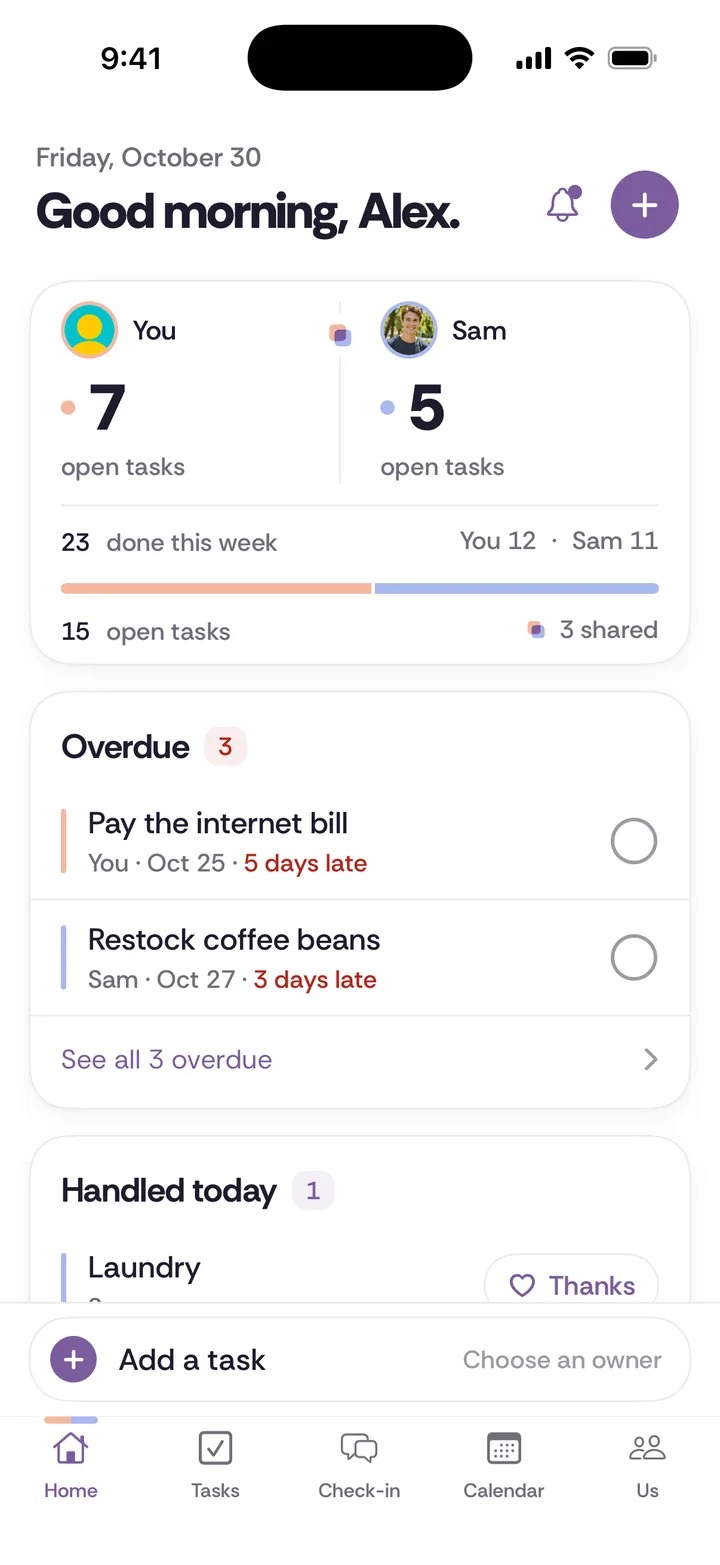
The easiest way to bring up something with your partner is to write it down when you think of it and talk about it at a set time, instead of raising it on the spot. Check-in topics in Tiptoe do exactly that: you add a topic during the week, it waits on the check-in list, and when you sit down together you pick one manageable topic and save a decision, a note or a next step.
Who is this for?
Anyone who has ever held a thought for three days because the timing never felt right. A wife who wants to talk about the in-laws' visit but not while her husband is stressed. A husband who keeps meaning to mention the credit card bill. A girlfriend who notices she has done every grocery run for a month and does not want to make it a thing. A boyfriend who wants to plan a trip but forgets every time they are both free. The thought is reasonable. The problem is where to put it until you talk.
What problem does it solve?
Most of what couples avoid saying is small. It gets avoided because there is never a neutral moment, so it either gets swallowed or comes out sideways in a bad one. Swallowing it builds resentment. Blurting it starts a fight about tone instead of the thing itself.
A topic list separates noticing from discussing. You notice on Tuesday and write it down. You discuss on Sunday, when you both expected to. Nobody is ambushed and nothing is lost. This is the practical version of saying the thing instead of tiptoeing around it.
How it works, step by step
Step 1. Add a topic while it is on your mind. Open Check-in and add it. Either partner can add topics during the week.
Step 2. Write it as a question or a request, not a verdict. "Can we talk about how we split school pickups?" invites a conversation. "You never do pickups" starts a defense. Topics on the check-in list are visible to your partner, so read it over before you add it.
Step 3. Let it wait. It sits on the list until your next check-in. You do not have to carry it in your head, and you do not have to find the moment.
Step 4. Pick one manageable topic when you sit down. Not the whole list. If both of you added something, take one each, starting with the smaller one.
Step 5. Save a decision, a note or a next step. Sometimes the outcome is a task ("call the school about late pickup, Sam, by Thursday"). Sometimes it is just a note ("agreed: no work email after 8"). Sometimes there is nothing to decide, and that is fine too.
Step 6. Save a bigger topic for next time if it needs more room. A topic like "should we move closer to your parents" will not fit in twenty minutes. Moving it to next week is not avoiding it. It is giving it the time it needs.
Three household examples
- The dishwasher. One partner notices they always unload it. Instead of sighing at the open door, they add: "Can we decide who owns the dishwasher, start to finish?" On Sunday it takes five minutes. One person owns it, including buying the pods.
- The visit. "Your sister wants to stay the week of the 12th. How do you feel about that?" goes on the list on Monday. By Sunday you have both had time to think, and the talk is about dates, not about whether it was rude to ask.
- The thing that is not about chores. "I'd like us to have one evening a week with no phones." It is not a complaint. It is a request, and it gets a next step: Wednesday, starting this week, with one partner owning the dinner plan. The date nights guide has ideas for that evening.
Good topics and harder ones
Good check-in topics are specific and fixable this week: one chore, one plan, one money decision, one thing that bothered you. Our guide on how to bring up something small has phrasing for these.
Harder topics, like a long pattern of resentment, are still worth putting on the list, but start smaller than you think. Name one recent example and one request. If you are worried about tone, the what to say tool gives three ways to phrase common situations.
If a topic involves fear, control or threats, do not put it on a shared list your partner can read. Go to our safety page instead.
What it does not do
- Topics are not private. Everything on the check-in list is visible to your partner. Do not use it as a diary or a place to vent.
- It does not resolve the conversation for you or suggest what to say. It holds the topic until you talk.
- It is not therapy or mediation, and it does not promise any outcome for your relationship.
- It does not decide which topic goes first. You pick one together.
- The weekly check-in, including topics, is included in the free account. Pro adds every past check-in.
How does it compare to a notes app, Apple Reminders or paper?
A shared note is a reasonable topics list, and if you already have one, it will do the job. The gap is what comes next: decisions sit in the note and never become anyone's task.
Apple Reminders can hold topics as items on a shared list. As of November 2026, Apple's support page says people on a shared list can add, delete and complete items, so either of you could add a topic. It has no check-in structure around it, so you would need your own routine for when you talk.
Paper works well for this. A sticky note on the inside of a kitchen cupboard, or one notebook page labeled "To talk about." Free, visible to both of you, and slightly harder to write something angry on because it is in your own handwriting. Bring it to your weekly talk.
Tiptoe is useful when you want the topic, the talk and the resulting task with an owner in one place, connected to the rest of your weekly check-in.
How to start this week
Each of you adds one topic before your next check-in. Make one of them easy, so the first conversation is a win. Talk about one, save one next step, and move the other to next week if you run out of time.
Related guides
- Weekly check-in for couples
- How to stop nagging
- Couples money talks
- When your partner doesn't help
- Communication for couples
Questions about check-in topics
How do I bring up something that bothers me with my husband or wife?
Write it down when you notice it, then raise it at a time you both set aside, with one recent example and one specific request. "Can we talk about who handles school pickups? This week I did all five" is easier to hear than a general complaint.
What should couples talk about in a check-in?
One thank-you, the week ahead, and one or two topics either of you added during the week. Good topics are specific and fixable: one chore, one plan, one money decision.
How do I tell my boyfriend or girlfriend something without starting a fight?
Pick a calm, expected time instead of the moment it bothers you, phrase it as a question or a request, and keep it to one topic. If it needs more time, agree to continue next week.
Can my partner see the topics I add?
In Tiptoe, yes. Topics on the check-in list are visible to your partner, so read one over before you add it. Nothing on the list is sent to anyone else.