Appreciation means telling your partner, specifically, what you noticed and why it mattered: "Thanks for calling the insurance company during your lunch break. I was dreading it." It's different from a general "thanks for everything", and it doesn't come with a request attached. It's also no substitute for a fair split, as anyone who has been thanked for doing all of it can tell you.
What the research and the Gottmans say
"Appreciation" is an ordinary word, not a coined term, but two lines of work are worth knowing.
Gordon, Impett, Kogan, Oveis and Keltner (2012) ran a series of studies on appreciation in romantic relationships, published in the Journal of Personality and Social Psychology. People who felt more appreciated by their partners reported being more appreciative in turn. More appreciative people reported being more responsive to their partners' needs, and were more committed and more likely to remain in their relationships over time. Outside observers also rated them as more responsive and committed in the lab.
The Gottman Institute treats this as a skill. Sharing fondness and admiration is the second floor of its Sound Relationship House and is described as "the antidote for contempt". Therapist Zach Brittle's article offers an exercise from The Seven Principles for Making Marriage Work: "I appreciate that you are ___. I noticed it last week when ___." He suggests at least three such statements a week.
The useful part of that formula is the second half. It gives evidence.
What specific sounds like
- For a chore that disappears. "You've taken out the recycling every week since March, and I never think about it anymore. That's a real relief."
- For planning. "You noticed the passports were expiring before I did. That would have ruined the trip."
- For a hard call. "Thanks for telling your mom we can't come. I know that wasn't easy."
- For who they are. "I like how patient you were with him over the math homework. You didn't sigh once."
- For something small. "You warmed up my car. I noticed."
- For a job in progress. "I know school pickup has been a mess with your new hours. You've kept it going anyway."
All of them name the thing. Several name the noticing and planning too, which is where thanks rarely reaches.
What it is not
- It is not payment. "Thanks for doing the bathroom" doesn't settle anything about who does the bathroom. A thank-you doesn't earn another chore, and receiving one doesn't take away your right to ask for a different arrangement.
- It is not a lead-in. "You're so great at this. Can you also do the taxes?" isn't appreciation. It's a request with a sweetener.
- It is not a substitute for sharing the work. Someone carrying most of the household won't be made whole with gratitude. Say thanks and move a job.
- It is not surprise that a grown adult did a chore. Thanking someone for "helping" with their own home can land badly. See ownership vs helping.
- It is not flattery. If it isn't true, leave it out.
What to do
Step 1. Once a day, notice one thing your partner did that you'd have had to do otherwise, or one thing you like about how they did it.
Step 2. Say it within a day, in one sentence, with the detail in it.
Step 3. Stop there. Don't follow with "and also".
Step 4. When you're thanked, try "Thanks for noticing" rather than "It was nothing". That helps the habit last.
Step 5. Go looking for invisible jobs. Ask, "What did you do this week that I probably didn't see?" Then thank them for one.
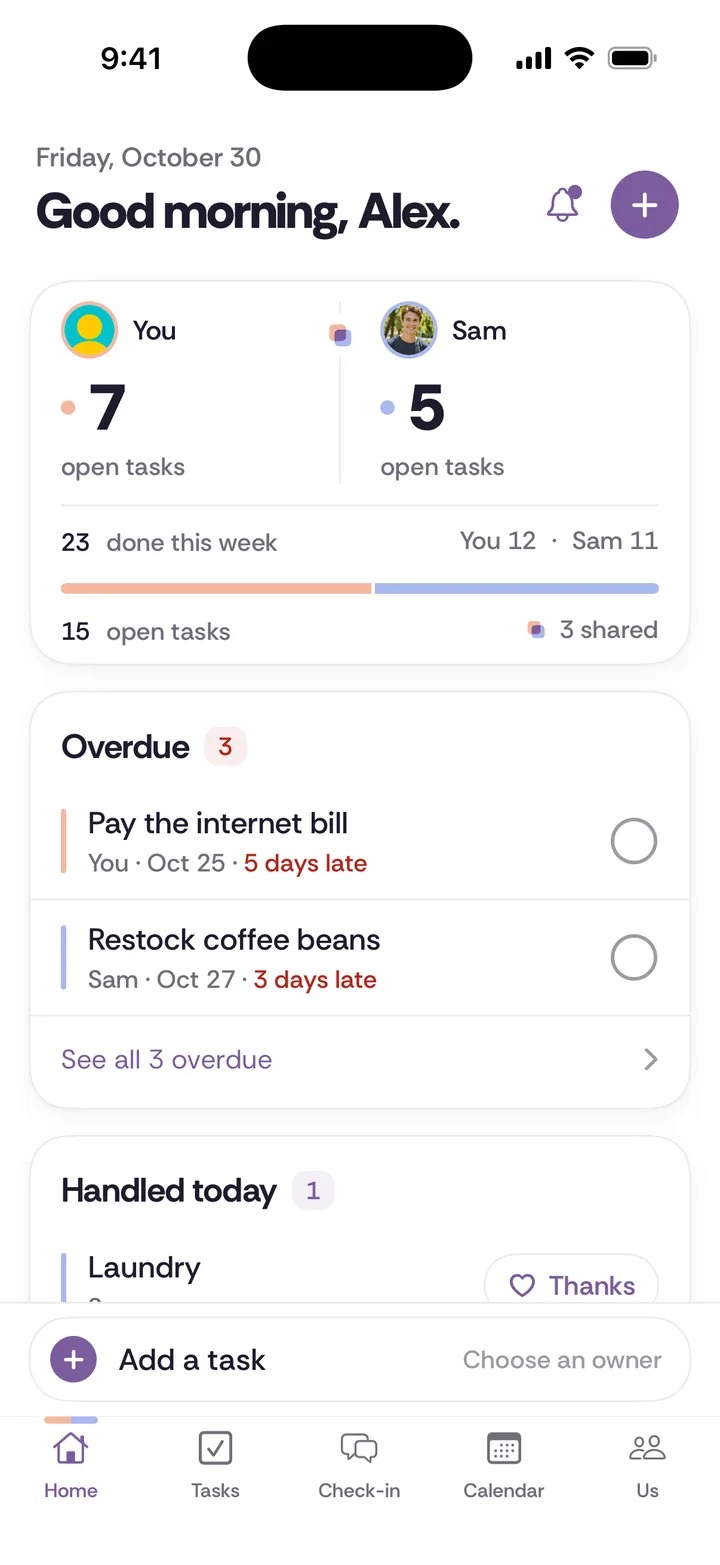
This is free, and it needs no app. A regular weekly check-in that opens with one thank-you each is an easy way to make it routine. In Tiptoe, there's also a one-tap thank-you on Home for what got done that day, which covers the small things. The bigger ones are still better said out loud.
Appreciation vs scorekeeping
Both involve noticing what your partner did, and the difference is what you do with it. Scorekeeping saves it for later, as a credit or a debt: "I did bedtime three nights, so you owe me." Appreciation gives it away immediately, with nothing owed. If your thanks would make your partner wonder what's coming next, you're probably closer to keeping score. And if you find yourself tracking how often you get thanked, say so directly at a calm time. It usually means the split itself needs a look, so start with what to do when one partner does more.
Questions about appreciation
How do I show appreciation to my husband or wife without it sounding fake?
Be specific and brief. Name one thing you saw and why it mattered. "You got up with the baby so I could sleep before my presentation" sounds real because it could only be about them. Generic praise is what tends to sound fake.
Why should I thank my partner for things they're supposed to do?
You don't owe thanks as payment, and it doesn't change the agreement. But noticing routine work is pleasant to receive whoever owns it, and the research on appreciation suggests that it tends to travel in both directions.
What if I never feel appreciated by my boyfriend or girlfriend?
Tell them one specific thing you'd like noticed, once, at a calm time. People often don't see what's been done for them. If the real issue is that you're doing most of the work, raise that separately, since more thanks won't fix it.