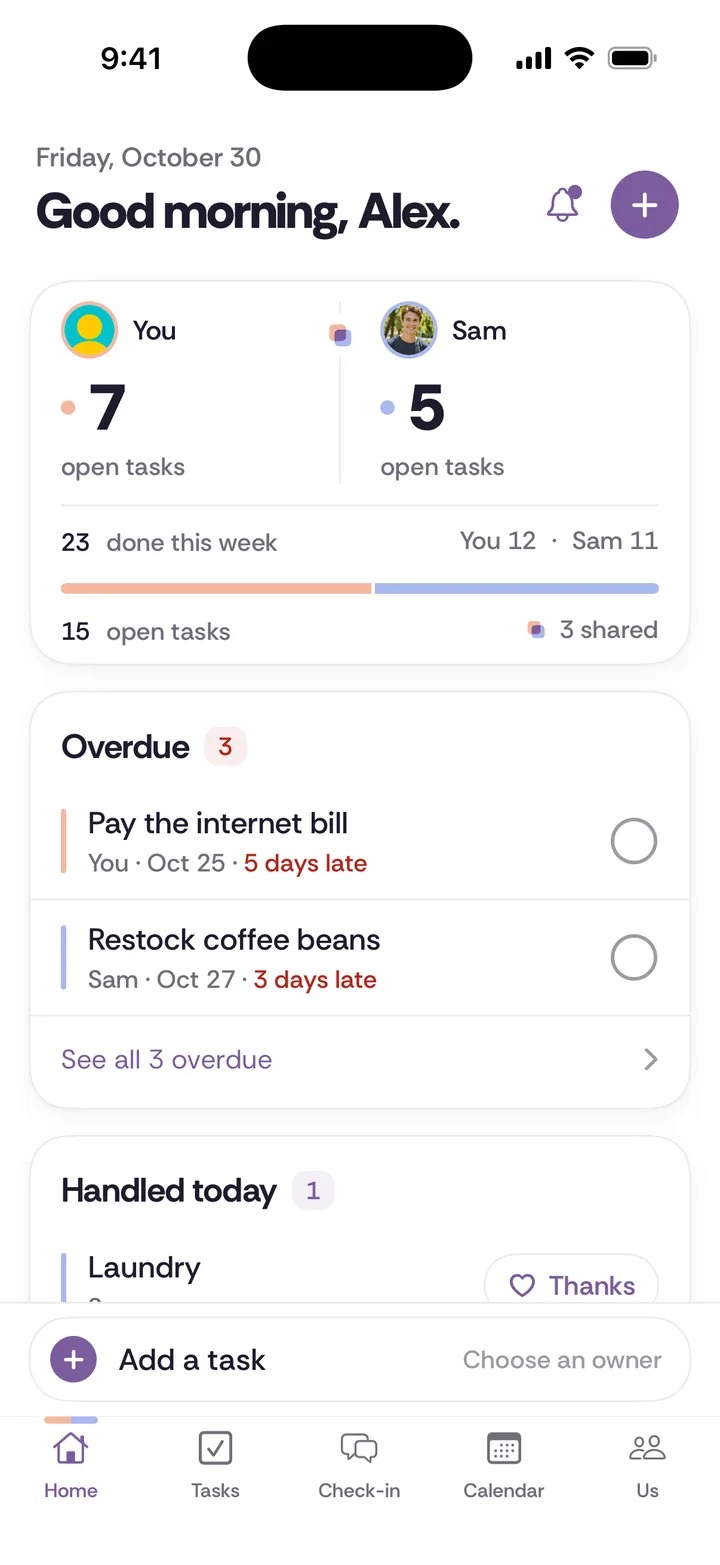
Anti-scorekeeping is a way of seeing household work clearly without turning it into a tally of who owes whom. You can know exactly who owns what and what got done, and still have no winner at the end of the week. It doesn't mean ignoring a lopsided split. It means taking that problem to a conversation, not a ledger.
Where the term comes from
"Anti-scorekeeping" is our term, used to describe how we design Tiptoe, and it won't appear in research papers. The idea underneath it has a long history in social psychology.
Margaret Clark and Judson Mills distinguish communal from exchange relationships. Clark writes in a book chapter on compatibility that in exchange relationships, benefits "are given to repay specific past debts or with the expectation of receiving a comparable benefit in return". She also reports evidence that repayment for specific benefits suits exchange relationships but not communal ones.
A related experiment, Clark, Mills and Powell (1986), looked at what people keep track of. When they could not be repaid in kind, people who wanted a communal relationship paid more attention to the other person's needs than people who wanted an exchange relationship. In short, what you're tracking differs: needs rather than debts.
These experiments weren't about couples dividing chores, so don't treat them as proof about your kitchen. They are a good way to describe the two mindsets.
Keeping score vs seeing the work
Same week, two ways to look at it:
- Bedtime. Score: "I've done four nights, so you owe me Saturday." Seeing the work: "Bedtime has been mostly me since your project started. Can we look at next week?"
- Dishes. Score: "That's the third time I've done yours." Seeing the work: "Dishes are yours, and they've been missed three times this week. What's going on?"
- A night out. Score: "You went out Tuesday, so I get Friday." Seeing the work: "I'd love a night with my friends soon. Is Friday okay?"
- Sick day. Score: "I stayed home last time." Seeing the work: "My Thursday is hard to move. Can you take this one?"
- Thanks. Score: "I did all that and got no thanks." Seeing the work: "I'd really like you to notice the school stuff. It's been a lot."
- Credit. Score: a whiteboard with points. Seeing the work: each job has an owner, and when it's done it counts for that person, with no totals on a leaderboard.
What it is not
- It is not pretending things are even. If one person does most of the work, say so. A wish not to keep score can't be a reason for one person to stop raising it.
- It is not refusing to count anything. Hours can help when you're diagnosing a split. Our chore split calculator does this. The difference is using a count once to make a decision, rather than keeping a running balance to use in arguments.
- It is not 50/50. Fair doesn't need to mean equal in any given week.
- It is not "don't be petty". Someone who's keeping score is usually tired or unseen, and is trying to make that known. Take it seriously. Then find a better tool.
How to stop keeping score
Step 1. Replace turns with owners. Most of the counting happens around jobs without a clear owner. If the trash is always one person's, no one needs to count who did it last.
Step 2. Say the feeling, not the tally. Try:
"I've noticed I'm counting, and I hate it. I think it means I feel like I'm carrying more than I want to. Can we look at the actual split on Sunday, instead of me keeping track in my head?"
Step 3. Review on a schedule. A weekly check-in gives concerns somewhere to go, so they don't need saving up.
Step 4. Say thanks without entering it in the ledger. See appreciation.
Step 5. Rebalance on the facts. If it's truly uneven, use the guide on what to do when one partner does more.
A paper list of who owns what works for this. Tiptoe's take is to assign each job to one person and credit it to that person, with Insights on completed work on Pro and no scores or rankings.
Anti-scorekeeping vs fairness
Fairness is the goal, and anti-scorekeeping is about how you get there. You can have a fair home with no tally, and you can have a detailed tally in an unfair one. A running tally answers "who's ahead?". What most couples actually need answered is "does this arrangement still work for both of us?". That second question can be asked out loud at any time, and it doesn't need a running total.
Questions about anti-scorekeeping
How do I stop keeping score in my relationship?
Give recurring jobs one owner so there's less to count, and move complaints to a regular check-in so they don't need saving up. When you catch yourself counting, take it as a sign you feel overloaded, and say that instead.
Is keeping score always bad?
Noticing an imbalance isn't. A one-time count of hours can be useful to start a conversation. It tends to go wrong when the count becomes a running balance that gets brought out in arguments, because then each partner's work turns into evidence.
What if my husband or wife says I keep score, but the split really is unfair?
Both can be true. Separate them: agree to stop trading tallies, and in the same conversation, ask for a specific change to the split. Bring the whole list of jobs, not a record of last week's misses.