A love map is your working knowledge of your partner's life: what they're worried about this week, who their closest friends are, what they hope happens next. It's a Gottman Institute term, and it stays useful only if you keep updating it. What you knew about your partner five years ago is not a love map. It is an old map.
Where the term comes from
Love maps come from the work of John and Julie Gottman. The Institute's Build Love Maps article describes a love map as "the term for that part of your brain where you store all the personally important information about your partner's life". It calls the principle "knowing the little things about your partner's life".
Love maps are the first floor of the Sound Relationship House, the Gottmans' seven-level model of a relationship. The floor above it is sharing fondness and admiration, and the walls are trust and commitment. The same article says couples with detailed love maps are better prepared to cope with stress and conflict. The Institute elsewhere describes them as an "ongoing and ever-evolving understanding of your partner's world".
The exercise in that article includes questions such as "What stresses your partner right now?" and "What is your partner's fondest unrealized dream?". Notice the first one has a shelf life. The right answer in November may be wrong by March.
What a current love map looks like at home
The Institute's questions are good. These are the same idea applied to an ordinary week, written by us:
- Work. You know the reorg was announced Tuesday, and that it's the new manager that worries your partner, not the workload.
- Family. You know the call with their sister was tense, and you know not to bring her up at dinner tonight.
- Food. You know they stopped drinking coffee after 2 p.m. two months ago, and why.
- Health. You know the knee is why they skipped the run, and that they'd like you not to ask about the MRI until Thursday.
- Friends. You can name the two people they'd call first, and you know one of them just moved.
- Dreams. You know they've been looking at nursing programs, even if they haven't decided anything.
None of this is dramatic. All of it would take about ten minutes to learn, if you asked.
What it is not
- It is not a quiz. Getting one wrong doesn't mean anything about your relationship. It's a reason to ask.
- It is not surveillance. You learn by asking, and your partner chooses what to share. Checking their phone or location is the opposite of this. If you feel monitored, or you are afraid to answer, please see our safety page.
- It is not a file of private judgments. "They always overreact about money" doesn't belong on a love map. "They grew up without much money, and it still scares them" does, if they told you so.
- It is not one and done. A long relationship can actually make this harder, because you stop asking what you think you already know.
How to update yours
Ask an open question, then listen without fixing.
Step 1. Pick a low-stakes moment, like a drive, the dishes or the walk with the dog.
Step 2. Ask something with a current answer. Try one of these:
- "What's taking up the most room in your head this week?"
- "Who at work are you enjoying right now?"
- "Is there anything you've been thinking about lately that you haven't told me?"
- "What's something you wish you had more time for this year?"
Step 3. Follow up with one question, not advice. "What's the worst part of it?" usually works.
Step 4. Remember it, and ask about it again next week. That second question is the part that shows you were listening.
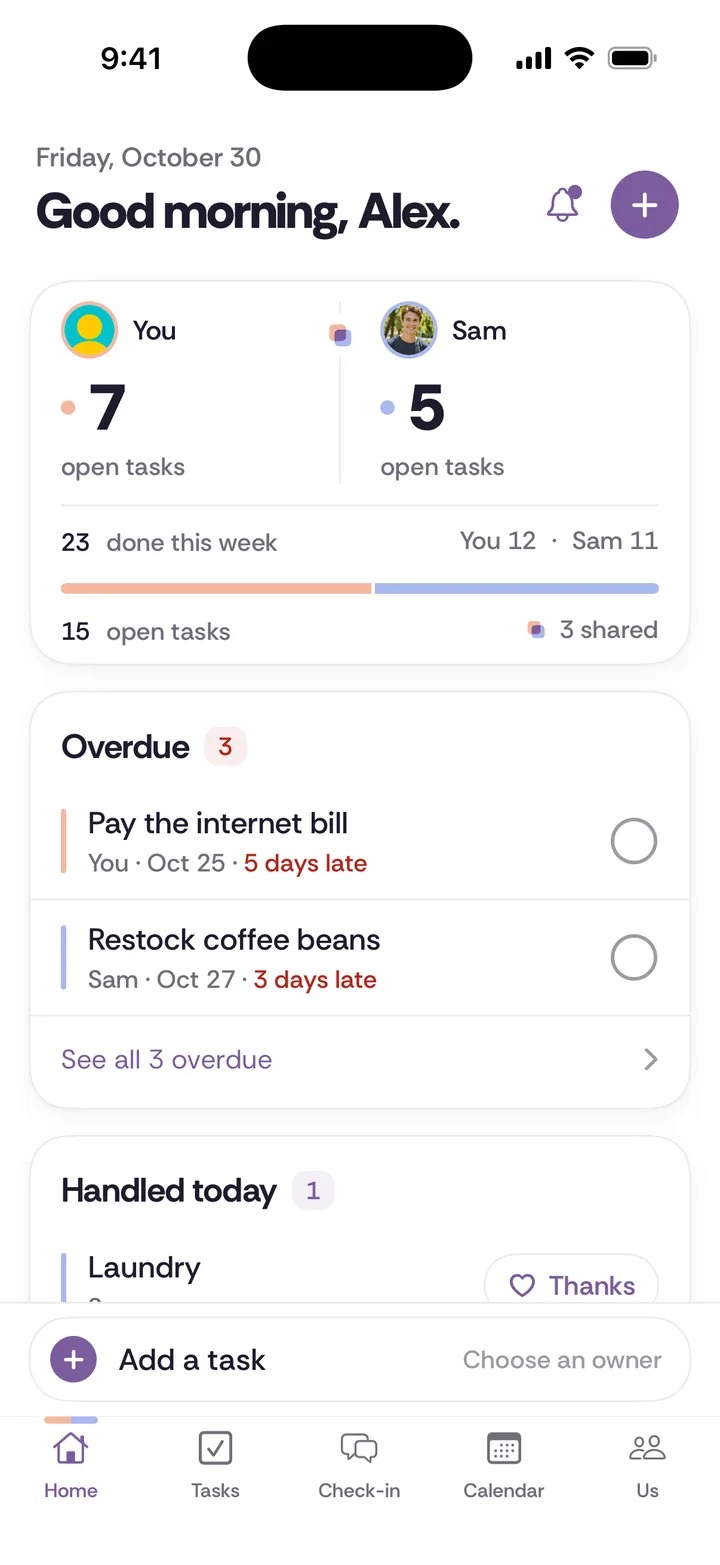
If you'd like prompts, our free check-in question library has 40 you can use with no app. A regular weekly check-in also gives these questions a place. In Tiptoe, a partner profile holds shared facts you've learned, and gift ideas you save there stay private to you. Be aware those profile facts are visible to your partner, so it's not a private journal.
Love map vs partner profile
A love map lives in your head and in your conversations. A partner profile is a written record of some of it, such as sizes, favorite takeout and gift ideas. A profile can help you remember a fact. It can't tell you what's on your partner's mind today, so it doesn't replace the asking. The love map is the relationship skill, and the profile is just a note. Love maps also differ from appreciation, the next floor up: one is what you know, and the other is what you say out loud about what you value.
Questions about love map
What are examples of love map questions?
The Gottman article's exercise includes naming your partner's two closest friends, what stresses them right now and their fondest unrealized dream. For everyday use, try "What's taking up the most room in your head this week?"
How do I build a love map with my boyfriend or girlfriend?
Ask open questions regularly, and follow up on the answers next time. It works early in a relationship as well as later, because the point isn't to memorize facts. It's to keep learning, and to show you remember what you heard.
Is a love map only for married couples?
No. Married couples were a major focus of the Gottmans' work, but the idea of staying curious about someone's current life works for any committed couple, including people who aren't married or don't live together.