Weaponized incompetence is when someone avoids a task by claiming they can't do it, or doing it badly enough that someone else takes over. It can happen with a husband, wife, boyfriend or girlfriend, and it is often not a conscious plan. What separates it from an honest skill gap is whether the person is trying to get better.
Where the term comes from
This is an internet-era label rather than a research finding, and we could not verify who first used it. Psychology Today says it is also called strategic incompetence and describes someone who "knowingly or unknowingly" shows an inability to do certain tasks, which leaves others to take on more of the work.
Two points from clinicians help keep the term honest. Cleveland Clinic psychologist Susan Albers says it can be done "consciously or unconsciously", and offers the most useful single test: "what you want to see is an attempt to improve." And Carly Dober of the Australian Association of Psychologists told RNZ it is a non-clinical term and that "there is no data on it", though she hears about it often in practice. Treat it as a useful description. It is not a diagnosis.
Examples at home
- The groceries. Your partner comes back with the wrong items for the third time this month, and the shopping quietly returns to you.
- The soak. Dishes are left to soak for days until you do them because you can't stand it anymore.
- The diaper. "You do it, you're so much better at this than me." Praise is a very effective way to hand over a job.
- The dinner. Asked to cook, your partner says "I'm a terrible cook, what should I make?" Now the planning is yours again, as Psychology Today's example describes.
- The school form. It gets filled out wrongly, the school calls you, and from then on you fill it out.
- The instructions. Someone asks for every step, every time, then says the result is your fault because you didn't explain it clearly.
One mistake is not the pattern. Repetition is what matters, and specifically repetition without any learning.
What it is not
- It is not a first attempt. Everyone is bad at a job they have never done.
- It is not disability or a health condition. ADHD, depression, or a stretch of exhaustion can make tasks go wrong for reasons unrelated to avoidance. These still need a workable plan, but they call for different conversations.
- It is not your partner's method being different from yours. If the towels are clean but folded in thirds, that may be gatekeeping running the other way.
- It is not a word to win a fight with. As a label thrown at someone mid-argument, it mostly produces defensiveness. Flinders University's Michael Wenzel makes a similar point in the RNZ piece, noting the label may not help every conversation.
If this feels less like avoidance and more like someone keeping you stressed or under control, the RNZ article describes that as a more serious end of the range. Please see our safety page.
What to say, and what to do next
Describe the pattern and leave motive out of it.
"The grocery run has come back to me three times since we agreed it was yours. I don't want to argue about why. I'd like to know what would help you own this, and then I'm staying out of it, even if we run out of something."
Then follow these steps:
Step 1. Ask what is actually hard. "I don't know which yogurt" is a five-minute fix. Write it down once.
Step 2. Agree on what done means, so "bad at it" has a definition.
Step 3. Don't rescue. Albers advises against stepping in, because it signals the slack will be absorbed. If the kids are safe, let the wrong yogurt stand.
Step 4. Check back at a set time, not at the moment of failure.
Step 5. Check your own side. Albers also suggests asking whether your perfectionism or people-pleasing is feeding the loop.
Step 6. If nothing changes after several rounds, counseling is a reasonable next step, individually or together.
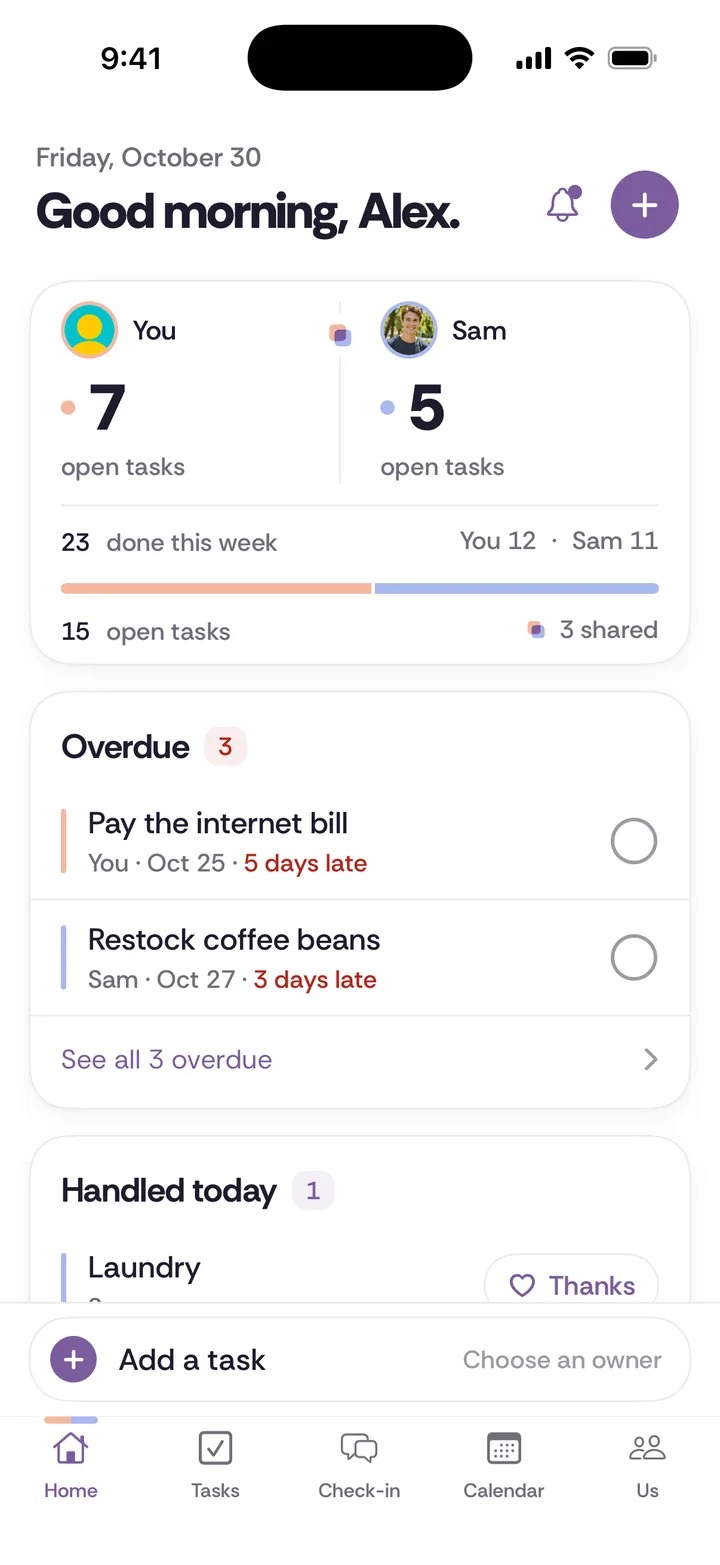
A longer version of this conversation is in what to do when one partner does more. If you'd like the agreement written down, paper works, and so does a task in Tiptoe with one assigned owner.
Weaponized incompetence vs gatekeeping
These two are close to mirror images, and a home can have both. In weaponized incompetence, the work moves away from someone through poor results. In gatekeeping, the work is held back from someone through tight control. The same handover can fail from both ends: one partner does the laundry badly, and the other re-washes it. It helps to ask both questions before deciding which one you have: is there an attempt to improve, and is there room to do it differently?
Questions about weaponized incompetence
How do I know if my husband or wife is doing this on purpose?
You often can't, and you don't need to. Look at behavior over time: does the task improve after instructions and practice? Dr. Albers's test is whether you see an attempt to improve. The conversation works better when it is about the repeated gap rather than about intent.
Is weaponized incompetence a form of abuse?
Not usually on its own. RNZ reports psychologist Carly Dober describing a range, from anxiety about criticism to, at the extreme, keeping a partner stressed or controlled. If you feel afraid or controlled, please see tiptoe.ai/safety/ and talk to someone qualified.
What if my boyfriend or girlfriend really is bad at a chore?
Then trade or teach. Trade it for something they do well, or show them once and let them practice badly for a while. Real skill gaps tend to shrink with practice. That is the difference that matters.