Household gatekeeping means handing over a job while keeping control of it: re-folding the towels, redoing the school lunch, approving every choice. Researchers first studied this in mothers, and a husband, wife, boyfriend or girlfriend can all do it. It can be less about control than about being the one who will be blamed if something goes wrong.
Where the term comes from
The paper Allison Daminger calls the most cited on this topic is Allen and Hawkins's 1999 article in the Journal of Marriage and the Family. Studying 622 dual-earner mothers, they described three dimensions: reluctance to give up responsibility shown through rigid standards, outside validation of a mothering identity, and distinct ideas about what mothers and fathers should do. They classified 21% as gatekeepers, and those mothers did about five more hours of family work a week.
Later work added a useful distinction. Schoppe-Sullivan and colleagues (2015) describe gate closing, such as criticizing or redoing a father's childcare, and gate opening, such as asking his opinion or arranging activities for him to do with the child.
Daminger, who studies household labor, adds an important caution. She suggests "parental gatekeeping", since men can do it too. She notes Allen and Hawkins themselves warn it is unclear whether gatekeeping causes low involvement or responds to it. She also calls it "in some ways an adaptive response to an unfortunate reality", because women are often the ones held accountable for how things turn out.
So gatekeeping is a pattern worth discussing. It is not a reason to blame the person who does it.
Examples at home
- The laundry. You hand it over, and then you ask whether the sweater went in on cold.
- The redo. Your partner loads the dishwasher. You open it after they leave the room and rearrange the bowls.
- The list. "Can you take the kids shopping?" comes with instructions down to the brand of socks.
- The veto. Your partner picks a summer camp, and you find a reason why it won't do, then pick one yourself.
- The holding pattern. Only you have the pediatrician's login, and you have never quite found time to share it.
- The audience. You correct how your partner handles bedtime while the kids are listening.
What it is not
- It is not having standards. "The baby sleeps on her back" is a safety rule. "The onesies go in by color" is a preference. Gatekeeping lives in the second category.
- It is not an excuse to do less. "You always criticize me" doesn't end a job. Someone who is corrected can still own the job and discuss the correction.
- It is not the only reason work is uneven. Allen and Hawkins said so themselves.
- It is not about keeping someone from their kids out of fear or spite. If a partner blocks your access to children, money or information, or you feel afraid, that is outside this conversation. Please see our safety page.
How to open the gate
If you might be the gatekeeper, sort your rules first.
Step 1. Write your rules for one job. Mark each one safety, cost, deadline or preference.
Step 2. Keep the first three. Let go of preferences. This is where to agree what done means.
Step 3. Decide what you'll do when it bothers you. Leaving the room is a legitimate strategy.
Step 4. Say it out loud:
"I'd like to stop checking on the laundry. I'm going to tell you the two things that actually matter, then leave it alone, even if the towels look different. Tell me if you catch me re-folding them."
If you're on the receiving end, try this:
"When I do bedtime and you step in to correct it, I feel like I'm helping you rather than doing it. Can we agree what matters, and can you let me handle the rest my way?"
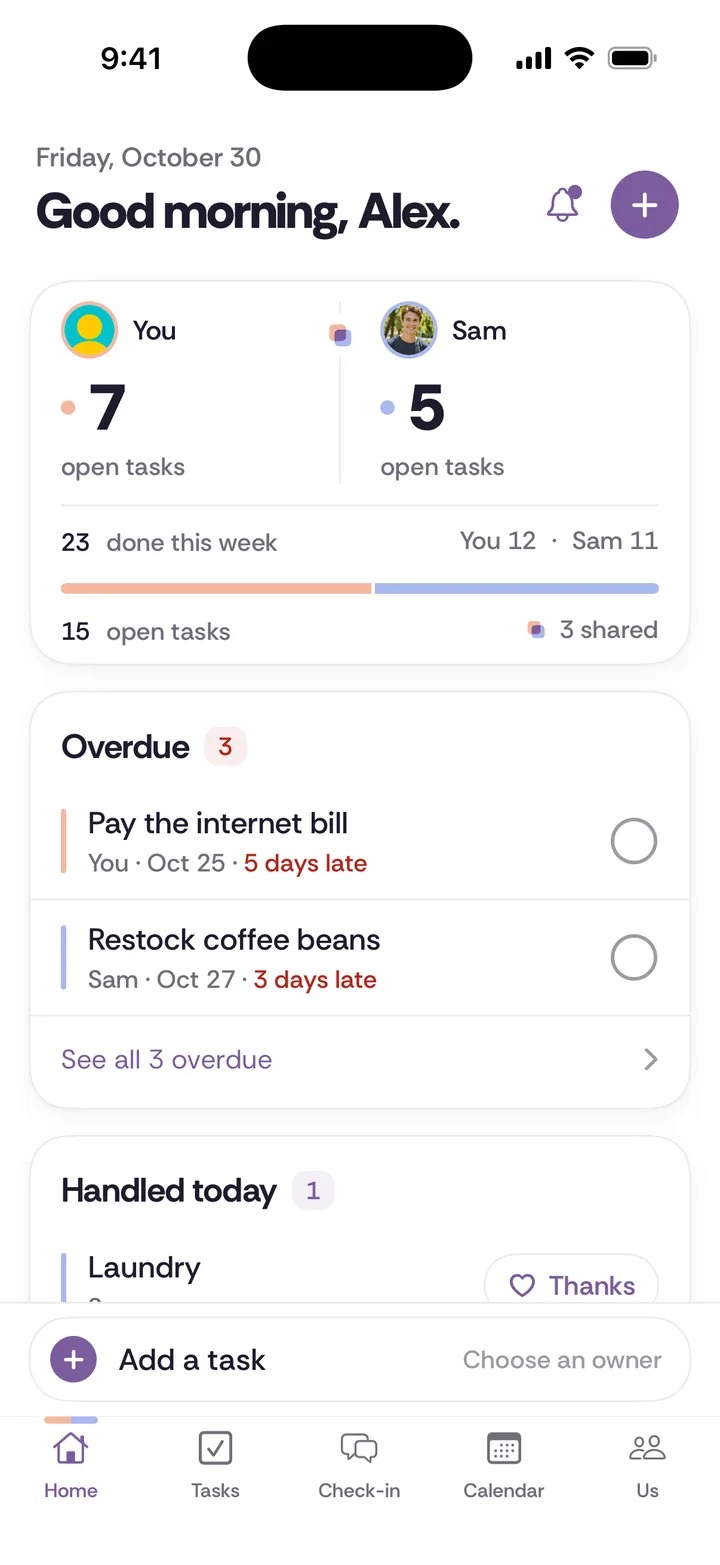
Then keep your side of it. Take the job in full, including the planning, and raise problems with it yourself. Our guide on splitting chores covers the whole handoff. A handoff written on paper is enough. If you keep it in Tiptoe, a chore has one owner, and handing it back has to be proposed and accepted.
Gatekeeping vs ownership
Ownership means carrying the job from noticing through follow-up, and that includes choosing the method. So ownership and gatekeeping can't both be true of the same job. If you own it, you decide how, within what you both agreed. If you hand it over, you hand over how as well. A previous owner who keeps supervising hasn't made a handoff. They've created a job for two people, with one still in charge.
Questions about gatekeeping
What is maternal gatekeeping?
It is the research term for mothers' beliefs and behaviors that limit fathers' involvement in family work, from Allen and Hawkins's 1999 paper. Later work separates gate closing, such as criticizing, from gate opening, such as encouraging. Daminger suggests parental gatekeeping as a more accurate name.
How do I stop redoing my partner's chores?
Sort your rules into safety, cost, deadline and preference, and drop preferences. Tell your partner what you are doing and ask them to call you on it. Then leave the room while the job is being done. It gets easier after a few rounds.
Is my husband or wife gatekeeping, or do they just have higher standards?
Ask whether the standard can be explained by safety, cost or timing. If so, it is probably a real requirement, and you can agree on it together. If it is about how something looks, and the job can only be done one way, gatekeeping may be involved.