Invisible labor is work nobody sees until it stops happening: the fridge that always has milk, the school shoes that fit, the thank-you note that got sent. Sometimes the person doing it is a husband or a girlfriend, sometimes a wife or a boyfriend. What makes it invisible is not who does it, but that its success looks like nothing happened.
Where the idea comes from
Sociologist Arlene Kaplan Daniels used the title "Invisible Work" for a paper in Social Problems in 1987. It grew out of her presidential address to the Society for the Study of Social Problems, and her 1988 book Invisible Careers looked at women's voluntary work. So the concept began well beyond the kitchen. It asked which activities a society bothers to count as work.
Household research later picked up the same problem. Allison Daminger's 2019 study of 35 couples found cognitive labor is often invisible both to the people doing it and to their partners. That second part matters. You may undercount your own work too.
Law professor Elizabeth Emens's publisher describes life admin as "an unseen form of labour" that goes without recognition or reward. Note that "invisible labor" is now an everyday phrase that covers more than Daniels's original subject, so people may mean somewhat different things by it.
Five examples you can test at home
Each of these looks like nothing until it stops:
- The refill. The hand soap, printer paper and dog food never quite run out, because someone keeps replacing them before they do.
- The wipe-down. The stove gets wiped after dinner, every night, after everyone has left the kitchen.
- The buffer. Someone leaves work early twice a month to be home for deliveries, and no one else knows the calendar was rearranged.
- The social thread. Someone answers the group text about Saturday, sends the address and remembers that your friend's partner does not eat shellfish.
- The reset. Someone walks through the house before bed moving shoes, closing the back door and starting the dishwasher.
A quick test: if this stopped for two weeks, what would break, and who would be surprised?
What it is not
- It is not secret martyrdom. Most people doing invisible labor are not hiding it. It simply never came up.
- It is not proof your partner does not care. Nobody notices what has always just happened. That is what the word invisible means.
- It is not a competition. Both partners usually hold some of this work. The goal is an accurate picture, not a verdict.
- It is not always worth keeping. Once a job is visible, you may decide it does not need doing at all. That counts as a good outcome.
How to make it visible without keeping score
Start from the work, not from who is falling short.
Step 1. For one week, each of you writes down things you did that the other probably did not see. Keep it to a dozen lines. No hours, no totals.
Step 2. Swap lists and read them. Mark anything that surprised you.
Step 3. For each surprise, choose one of three: keep it as it is, hand it over, or stop doing it.
Step 4. Thank the person for one specific thing you did not know about, and leave it there.
You might open with:
"I've noticed I couldn't tell you half of what you do around here, and you probably can't tell me half of what I do. Can we each write it down this week and compare on Sunday? I'm curious, not building a case."
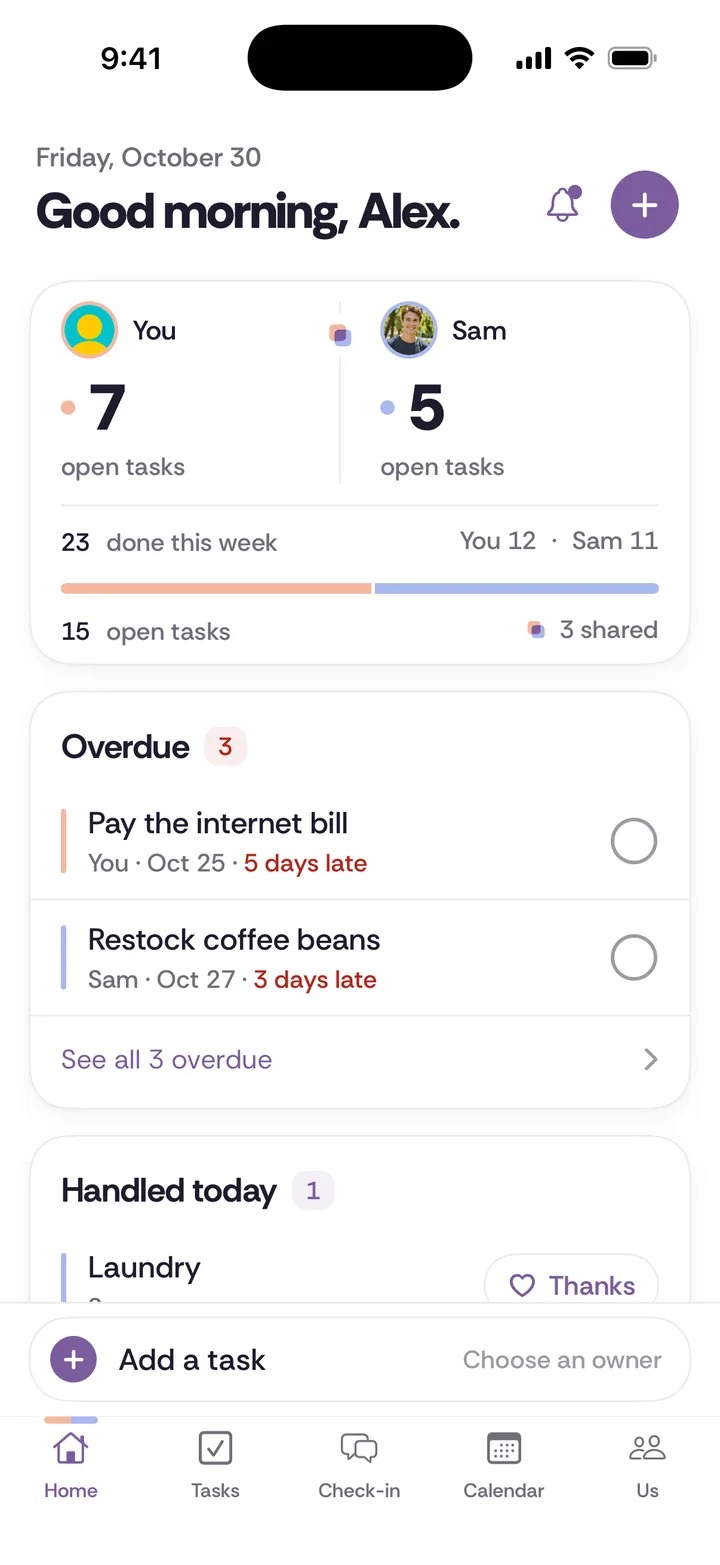
A paper list is free and works well. Our free chore split calculator adds hours and who plans each job. If a job should stay visible once you have named it, a shared task in Tiptoe gives it an owner both of you can see. New parents often find this list grows fast, and we have a guide for that stage.
Invisible labor vs mental load vs household admin
These three get mixed up, and a single example separates them.
- Invisible labor is about whether the work gets seen. Cleaning the gutters while your partner is away is invisible labor.
- [Mental load](/glossary/mental-load/) is about the thinking. Remembering the gutters are due each fall is mental load.
- [Household admin](/glossary/household-admin/) is about the paperwork and coordination. Getting three quotes and booking the gutter company is household admin.
One job can involve all three, which is why a list that only says "gutters" understates it.
Questions about invisible labor
What is an example of invisible labor in a relationship?
Restocking household basics before they run out is a common one. So is the nightly walk through the house that leaves it reset by morning. Neither shows up on a chore chart, and both are noticed mostly when they stop.
Why does my boyfriend or girlfriend not notice what I do around the house?
Often because the work succeeds quietly. When something never runs out, there is no event to notice. Daminger's research also found this kind of work can be invisible to the person doing it. Writing lists side by side tends to help more than asking your partner to notice more.
Is invisible labor the same as unpaid labor?
No. Unpaid labor is about money, and invisible labor is about recognition. A housekeeper's careful work can be paid and still go unnoticed, while a very public, celebrated dinner party can be unpaid and highly visible.