Emotional labor originally meant managing your feelings as part of a paid job, such as a flight attendant staying warm with a rude passenger. Today people, including many a husband, wife, boyfriend or girlfriend searching this term, use it for keeping the peace at home or remembering birthdays. Both uses are common, but only the first is what the term was coined to mean.
Where the term comes from, and how it drifted
Arlie Russell Hochschild introduced the term in The Managed Heart, which won the 1983 Charles Cooley Award. She studied two groups of public-contact workers: flight attendants and bill collectors. Her definition, as quoted by sociologists Michael James Walsh and Stephanie Alice Baker, is "the management of feeling to create a publicly observable facial and bodily display [that is] sold for a wage."
The book also uses a separate term, emotion work, for managing feelings in private life, guided by what she calls feeling rules. So Hochschild had a word for the home all along. It just was not the one that caught on.
Over the following decades, "emotional labor" spread to housework, to-do lists and holiday planning. Walsh and Baker quote Hochschild on this stretching: "It is being used to apply to a wider and wider range of experiences and acts." They argue that this overextension can hide the burdens the concept was meant to expose.
None of this makes your experience less real. It only means a more precise word may help you get what you need.
Which word fits what you are describing?
Six common situations, sorted:
- Calming your partner's mother before she arrives. Emotion work. You are managing feelings in private life.
- Softening every difficult text from relatives. Emotion work. If only one of you does this, name it.
- Smiling through a difficult customer's abuse, then coming home drained. Emotional labor in Hochschild's sense. It is paid, and it has a cost you carry home.
- Remembering to buy the card for your sister's birthday. Mental load, not emotional labor. It is planning, and no feeling is being managed.
- Keeping the kids cheerful through a long drive while you are exhausted. Emotion work, mixed with care.
- Booking the plumber. Household admin.
What it is not
- It is not all unseen work. Most of what gets called emotional labor online is planning or admin. Calling it the right thing makes it easier to hand over.
- It is not simply being considerate. Being kind to someone you love is not automatically a burden. It becomes a problem when it is one-way, expected and impossible to put down.
- It is not your job to manage fear. If you are managing a partner's moods because you are afraid of what happens otherwise, that is a different situation. Please read our safety page.
- It is not a clinical term. It came from sociology, and it does not describe a condition.
What to say or do
Name the specific feeling work, and ask for a specific change. "You don't do any emotional labor" gives your partner nothing to act on.
"When your brother sends those messages, I end up working out how to answer so nobody is upset. I'd like you to take his messages from now on, including the awkward ones. I'll stay out of it, even if you answer differently than I would."
A few more that work the same way:
- "Before my parents visit, can you be the one who tells them about the change of plans?"
- "After a hard shift I need 20 minutes before I can be cheerful. Can you take the kids until six?"
- "I don't want to be the one who reads the room for both of us at dinner with your friends. Can we talk about what you'd want to do when it gets tense?"
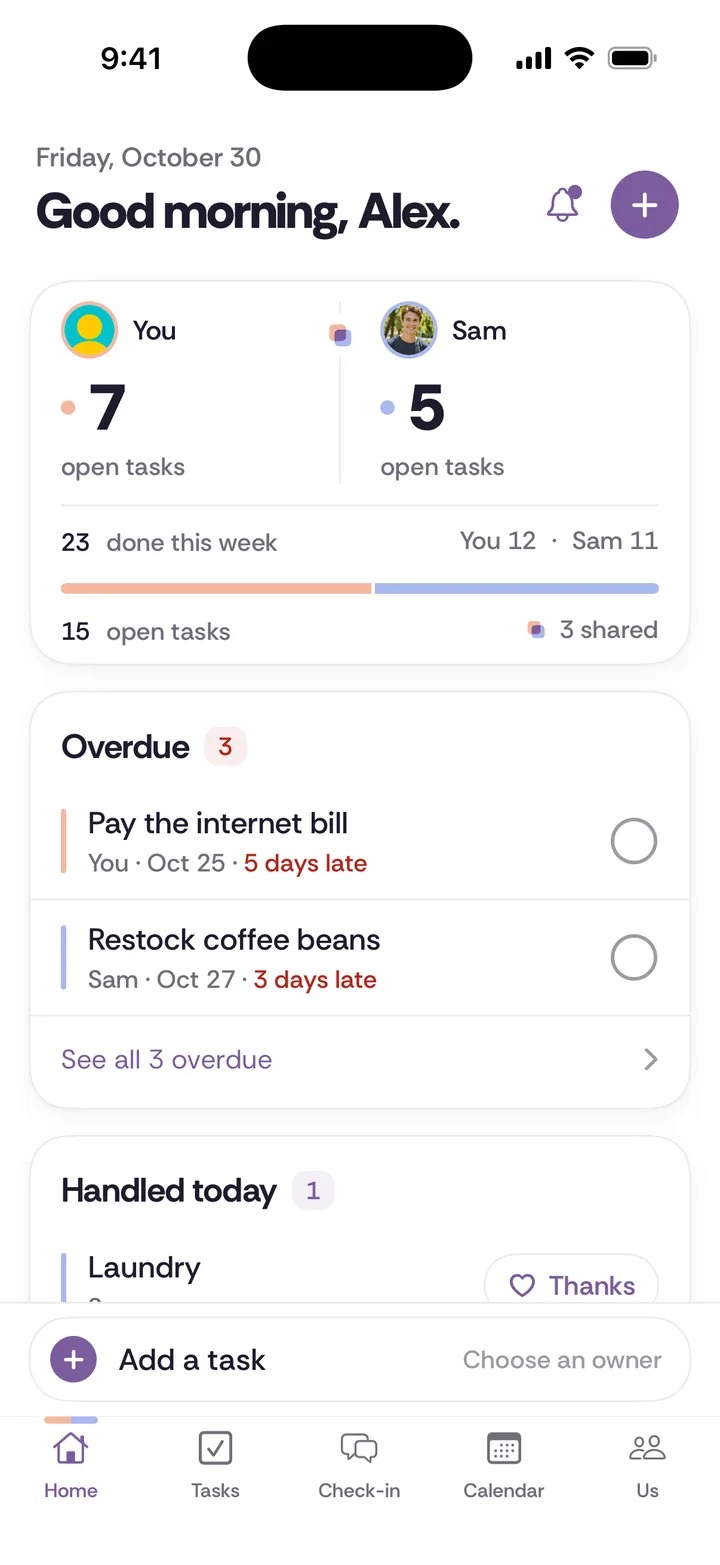
Those conversations go better when they have a set time. A weekly check-in can hold them, whether that is 15 minutes on a walk or the Check-in tab in Tiptoe. Holidays can bring it all up at once, so we also have a guide for two-family plans.
Emotional labor vs mental load
The easiest way to tell them apart is to ask what is being managed. Mental load manages information: what is due, what is missing, what is next. Emotional labor and emotion work manage feeling: yours, or how someone else's will land. Hosting Thanksgiving contains both. Knowing the oven holds one turkey and ordering the pies is mental load. Keeping your uncle and your dad away from each other for five hours is emotion work.
Questions about emotional labor
Who coined the term emotional labor?
Sociologist Arlie Russell Hochschild, in The Managed Heart, from her research on flight attendants and bill collectors. She defined it as feeling management sold for a wage, and used emotion work for the same effort in private life.
Is my wife or husband doing emotional labor at home?
In Hochschild's strict sense, no, because it is not paid. In everyday speech, many people would say yes. Emotion work is the more precise term, and it is usually more useful to name the exact thing, such as handling hard messages from relatives.
Is remembering birthdays emotional labor?
Usually it is better described as mental load, because the work is remembering and planning. If the task also involves managing how a difficult relative will feel, that part may be emotion work.